

AI search tools are changing how leads find you. Instead of typing a few words into Google, prospects are increasingly asking complete questions such as, “Which roofing companies near me have the best reviews?” or “What’s the best CRM for a 10-person service business?” The answer may come from Google AI Overviews, ChatGPT Search, Perplexity, Gemini, or another answer engine before the prospect ever sees a traditional list of blue links.
That does not mean SEO is dead, and it does not mean every business needs to chase every new AI platform. It does mean the path from discovery to inquiry is changing. In this article, we’ll explain what is actually happening in 2026, how AI-generated answers influence buying decisions, why citations and brand mentions matter, and what practical steps business owners can take now.
AI Search Tools Are Becoming a New Layer Between Search and Leads
The biggest change is not simply that people are using ChatGPT instead of Google. It’s that search is becoming more conversational, comparative, and action-oriented.
Google is adding AI directly into its existing search experience. In January 2026, Google announced Gemini 3 upgrades for AI Overviews and AI Mode, including follow-up questions that preserve context from the original search. In May 2026, Google also described additional ways AI Mode and AI Overviews help users discover original content and trusted sources through more complex searches. You can see those developments in Google’s update on Gemini upgrades for AI Mode and AI Overviews.
OpenAI has taken a different route by building web search into ChatGPT. ChatGPT Search provides timely responses with links to web sources, and OpenAI made the feature available to everyone in supported regions in February 2025. A prospect can now ask for recommendations, compare providers, refine the question, and then visit a business website without starting over in a conventional search box. OpenAI explains the product in its official introduction to ChatGPT Search.
For businesses, the practical implication is straightforward: your website is no longer competing only for a ranking. It may be competing to become one of the sources an AI system considers trustworthy enough to summarize, cite, or recommend.
What “visibility” means in an AI answer
Traditional SEO visibility usually means appearing on a search results page. AI search visibility can include:
- Being cited as a source inside an AI-generated answer
- Having your company mentioned as a recommended provider
- Being included in a comparison of products or services
- Supplying facts that an AI system uses to construct an answer
- Receiving a highly qualified visitor after the user has already narrowed the options
That last point matters. A visitor arriving from an AI recommendation may know more about your business than a visitor who clicked a generic “best local contractors” result. The volume may be smaller, but the intent can be stronger.
What the 2026 Data Says About AI Search and Website Traffic
The honest answer is that AI search is important, but it has not replaced traditional search traffic. The data shows a transition, not a total collapse of Google.
A 2026 report from First Page Sage found that organic search still represented 42.8% of website sessions, although it had lost share and volume compared with January 2023. The same report found that visitors from ChatGPT converted into leads at 4.7%, compared with 1.9% for Google organic traffic. That is a meaningful difference, but it should not be interpreted as a universal conversion rate for every industry or website. It is better understood as evidence that AI-referred visitors may arrive further along in the decision process.
Other research shows how quickly the AI referral market is developing. BrightEdge’s 2026 AI Market Pulse reported that ChatGPT accounted for 95% of measured referral traffic from AI search platforms, with Gemini, Perplexity, and Claude making up the remaining share. However, those figures describe tracked referrals from standalone AI platforms. They do not fully capture people who see your company in a Google AI Overview and then search for your brand directly, call you, or visit later.
That measurement problem is one of the most important things happening in AI search engine optimization in 2026. A business may be influencing a customer without receiving a clean, obvious referral in Google Analytics.
AI referrals are not the whole story
Suppose someone asks ChatGPT for three reputable web designers in Maui. Your agency is mentioned, but the person does not click immediately. Two days later, they search your brand name, visit your website, and schedule a call. Analytics may credit that conversion to direct traffic or branded search, not ChatGPT.
The same can happen when a Google AI Overview introduces a local business. Users may remember the name, look it up separately, or call from a phone number shown elsewhere. Therefore, AI visibility should be evaluated alongside:
- Branded search growth
- Direct traffic and assisted conversions
- Lead quality and close rates
- Calls and form submissions mentioning AI tools
- Whether your business appears for realistic customer questions
In other words, do not judge the channel only by last-click traffic. At the same time, do not accept vague claims that “AI is sending tons of leads” without looking at your actual data.
Why AI Answer Engines Choose Some Businesses Over Others
AI answer engines do not appear to use one simple ranking factor called “AI SEO.” They gather information from multiple sources, assess relevance, interpret the user’s question, and generate an answer based on the material they can find and trust.
That creates a different optimization challenge. Your goal is not merely to publish a page targeting “plumber Honolulu.” You need to make it easy for systems and people to understand what you do, where you operate, who you serve, what makes you credible, and which specific problems you solve.
Clear facts beat vague marketing language
AI systems are more likely to use information that is specific and easy to verify. “We deliver world-class excellence” says very little. “We provide emergency water damage cleanup across West Maui and offer 24-hour response” is more useful because it answers who, what, where, and when.
For a service business, that means your site should clearly explain:
- Your primary services and the problems they solve
- The cities, neighborhoods, or service areas you cover
- Who your ideal customers are
- Your process, qualifications, and relevant experience
- Pricing guidance or factors that affect cost
- Frequently asked questions and limitations
- How a prospect can contact or hire you
Independent signals matter, too. Reviews, reputable directories, local news coverage, industry organizations, supplier pages, and consistent business information can help confirm that your company is real and relevant. This is especially important for Perplexity business visibility, because Perplexity is designed around answers that include source citations and encourages users to inspect the underlying references.
That does not mean you should create dozens of low-quality profiles or attempt to manipulate citations. It means your business information should be accurate, consistent, and supported by genuine evidence across the web.
AEO vs SEO strategy: the practical difference
The best AEO vs SEO strategy is not to choose one. Strong technical SEO, useful content, fast hosting, crawlable pages, and clear internal linking remain the foundation. Answer Engine Optimization builds on that foundation by making individual facts and answers easier to extract, understand, and cite.
For example, a traditional SEO page might target “commercial cleaning services.” An AEO-aware version would also answer:
- What does commercial cleaning include?
- How often should an office be cleaned?
- How much does commercial cleaning cost in 2026?
- Do you serve small offices, medical facilities, or retail locations?
- What should a business ask before hiring a cleaning company?
Those questions reflect how people now use AI tools. They also make the page more helpful for human visitors, which is why the strongest AEO work usually looks less like gaming a system and more like answering customer questions properly.
How AI Search Changes the Lead Generation Journey
AI search compresses several stages of the buying journey into one conversation. A potential customer can ask for an explanation, request recommendations, compare providers, check reviews, and decide what to do next without visiting ten websites.
This has two important consequences for lead generation.
First, your business may be evaluated before a prospect reaches your website. If an AI system describes your company incorrectly, omits you from a relevant shortlist, or favors a competitor with clearer third-party evidence, you may lose the opportunity before you know it existed.
Second, the website visit that does happen may be more valuable. The prospect may arrive after asking several questions and already understand the difference between your service and a cheaper alternative. Your website then needs to confirm the recommendation quickly.
Turn AI-referred interest into an actual inquiry
A good AI visibility strategy cannot stop at being mentioned. Your website still has to convert attention into action.
Make the next step obvious. Use clear calls to action, short contact forms, visible phone numbers, service-specific landing pages, and helpful proof near the inquiry point. If you serve multiple locations or customer types, direct visitors to the most relevant page instead of sending everyone to a generic homepage.
This is also where ChatGPT lead generation tools and website automation can help. A properly configured chatbot can answer routine questions, qualify a visitor, collect contact details, and notify your team. However, automation should support a real sales process rather than hide a difficult-to-reach business behind a bot.
For local service companies, speed matters. An AI recommendation may create demand at any hour, including evenings and weekends. If nobody responds until the next business day, the lead may contact another provider. Even a simple automated acknowledgment, appointment request, or qualification flow can reduce that gap.
What Business Owners Should Do About AI Search in 2026
You do not need to rebuild your entire marketing program around AI this month. Start with the fundamentals that improve both traditional search and AI visibility.
- Audit your real-world information. Check your name, services, locations, phone number, hours, reviews, and ownership details across your website and major third-party profiles.
- List the questions customers actually ask. Ask your sales team, customer service staff, and recent clients what they wanted to know before contacting you.
- Create direct answers. Publish useful service pages, comparison pages, FAQs, buying guides, and location pages. Keep the language specific and avoid unsupported claims.
- Strengthen proof. Add case studies, author information, credentials, project details, testimonials, and links to reputable supporting sources where appropriate.
- Test the important prompts. Search your services in ChatGPT, Google AI Mode, Perplexity, and other tools your customers may use. Record whether you appear, how you are described, and which sources are cited.
- Measure business outcomes. Track qualified leads, branded searches, assisted conversions, phone inquiries, and close rates—not just clicks.
Most businesses should continue investing in foundational SEO, local visibility, conversion-focused web design, and a reliable website before spending heavily on experimental AI tactics. AI search is changing quickly, and no consultant can guarantee that a particular page will be cited tomorrow.
What you can control is whether your business is clear, credible, technically accessible, and genuinely useful. Those qualities travel well across Google, ChatGPT, Perplexity, and the next search product that gains traction.
Conclusion: Be the Business AI Can Understand and Recommend
AI search tools are changing how leads find you, but the shift is more practical than apocalyptic. Search is becoming conversational. Answers are becoming more synthesized. Prospects may discover your company through a citation, a recommendation, a comparison, or a follow-up question rather than a traditional blue-link result.
The businesses most likely to benefit are not necessarily the ones publishing the most content. They are the ones with accurate information, clear expertise, strong customer proof, useful answers, and websites that make the next step easy.
At The X Digital, we approach AEO as an extension of good digital marketing—not a shortcut around it. We build fast, useful websites, create content around real customer questions, improve local and technical SEO, and help businesses evaluate whether AI tools are producing meaningful visibility and leads. If your website is an important revenue channel, 2026 is a good time to find out how your business appears in the answers your prospects are already asking.
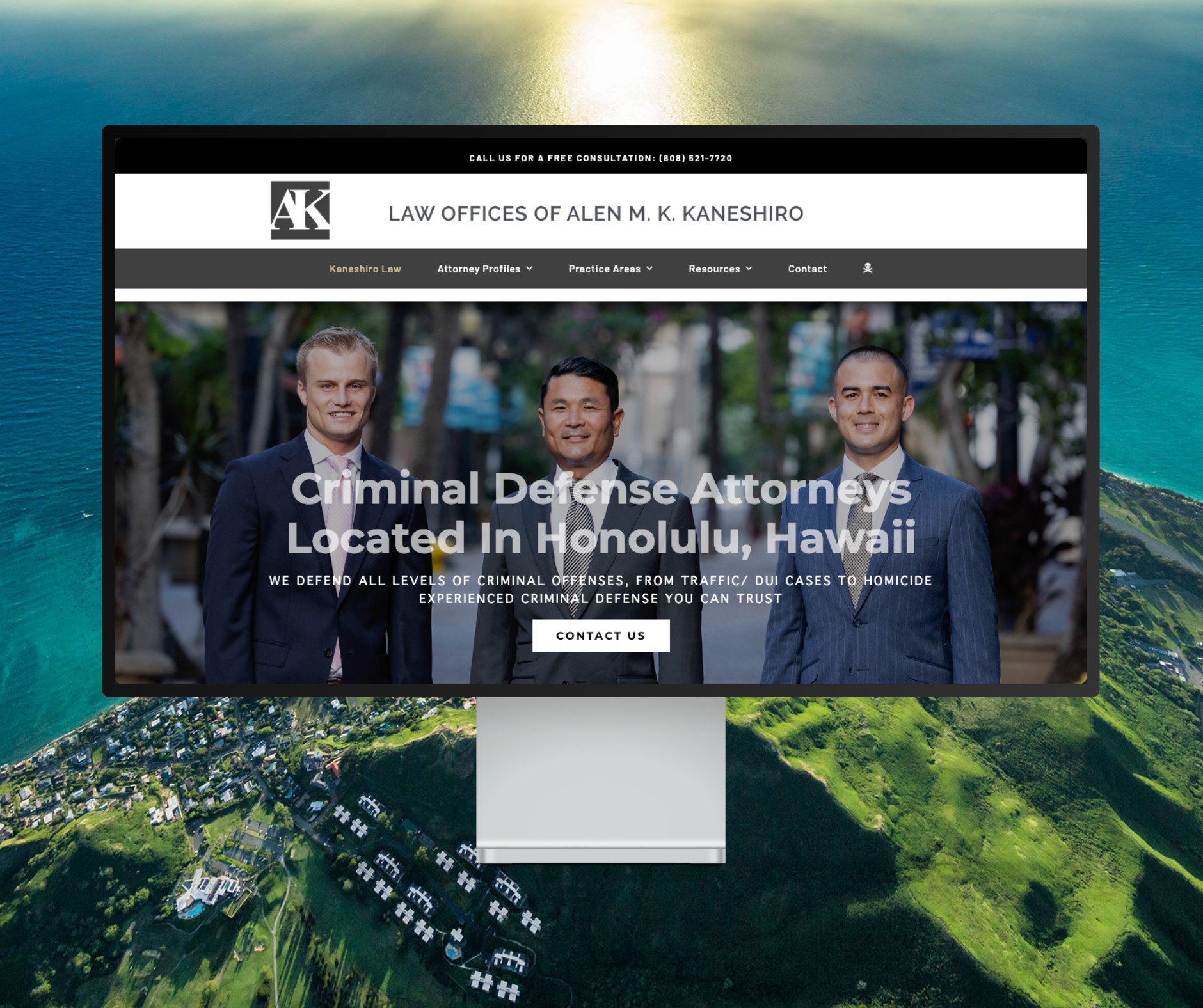
Featured Website: www.kaneshirolaw.com
Kaneshiro Law Firm, one of Hawaii’s most respected legal practices, partnered with The X Digital three years ago for a complete website redesign. Since then, we’ve maintained an ongoing relationship—handling updates, optimizations, and technical support around the clock. Our dedicated team ensures they’re never without assistance, while our enterprise-grade hosting provides 24/7 uptime monitoring and reliability. Kaneshiro Law Firm is one of many long-term clients who trust us to keep their digital presence running flawlessly.