

A strong local SEO strategy is no longer a “nice to have” for businesses that serve a specific city, neighborhood, or service area. It is often the difference between being discovered when someone needs help and being overlooked while a competitor gets the call. Local customers move quickly, compare several businesses, and increasingly use Google Maps, review platforms, social media, and AI tools before making contact.
That creates both an opportunity and a problem. You don’t need to dominate every search in your market, but you do need accurate business information, a trustworthy online reputation, useful service pages, and a website that makes taking the next step easy. In this article, we’ll explain what a comprehensive local SEO strategy includes, why it matters more now, and where a small business should focus first.
Why a Local SEO Strategy Matters More Than Ever
Local search is usually high-intent search. Someone looking for “roof repair near me,” “senior care in Maui,” or “best family dentist in Austin” is not casually browsing. They may be ready to call, request an estimate, book an appointment, or visit a location.
Recent BrightLocal research reinforces how quickly these decisions happen. Its 2026 Consumer Search Behavior study found that 84% of consumers had searched online for a local business within the previous three months. The same research reported that 75% make a decision in under 30 minutes, with 28% deciding in under five minutes. ([brightlocal.com](https://www.brightlocal.com/research/consumer-search-behavior-speed/?trk=article-ssr-frontend-pulse_little-text-block&utm_source=openai))
That short window changes what your marketing needs to accomplish. A potential customer may see your Google Business Profile, scan your reviews, look at your photos, check your hours, and visit your website before ever speaking with you. If any of that information is missing, outdated, confusing, or unconvincing, the customer can move on immediately.
Local search is not limited to Google
Google remains central to local discovery, but customers are no longer following one predictable path. BrightLocal’s 2026 research found that 73% of local business searches started on a mobile phone, compared with 19% on a computer and 8% on a tablet. The report also highlights the growing role of social platforms, review sites, Apple Maps, and AI tools in the research process. ([brightlocal.com](https://www.brightlocal.com/research/consumer-search-behavior-channels/?utm_source=openai))
For businesses, this means local search optimization is broader than adding a few keywords to your homepage. Your business needs to be understandable and trustworthy wherever customers look for local information.
What a Comprehensive Local SEO Strategy Includes
A complete strategy connects your Google Business Profile, website, reviews, local content, technical foundation, and business listings. These elements support one another. A strong profile may earn visibility, but a weak website can lose the lead. A well-designed website may attract traffic, but inaccurate directory listings can create doubt.
1. An accurate and complete Google Business Profile
Google explains that local results are primarily influenced by relevance, distance, and prominence. Relevance reflects how well your profile matches the search. Distance considers how far the business is from the searcher. Prominence relates to how well-known or established the business appears, including signals such as links and reviews. ([support.google.com](https://support.google.com/business/answer/7091?hl=en-11&utm_source=openai))
You cannot control a searcher’s location, and you cannot pay Google for better organic local rankings. You can, however, make your profile more complete and accurate. That includes:
- Choosing the most appropriate primary and secondary categories
- Writing a clear business description that explains what you do and where you serve
- Adding current hours, holiday hours, phone numbers, and service information
- Uploading high-quality photos of your team, location, vehicles, products, or completed work
- Adding relevant products or services where the feature is available
- Publishing useful updates instead of repetitive promotional posts
- Responding professionally to customer questions and reviews
This is foundational work, but it is frequently neglected. A profile with the wrong hours or an incomplete service list can lose customers even if it ranks well.
2. A website built for local customers
Your website should confirm that the searcher has found the right business. Every important service area should be easy to understand, especially for local services such as contractors, cleaners, landscapers, healthcare providers, and professional consultants.
At minimum, your website should clearly communicate:
- What services you provide
- Which cities, neighborhoods, or regions you serve
- Why customers should trust your business
- How to call, book, request an estimate, or visit
- What customers can expect from the process
That does not mean creating dozens of thin pages with city names swapped out. Low-quality location pages rarely help users and can make a website feel artificial. Instead, create genuinely useful pages that address local needs, explain your service process, answer common questions, and include evidence such as project photos, testimonials, credentials, or case studies.
Reviews, Reputation, and the Trust Signals That Win Customers
Ranking is only part of the job. Your local SEO strategy also needs to persuade people to choose you after they find you.
BrightLocal’s 2026 Consumer Search Behavior research found that consumers care about several factors during the research stage. The most important included the business’s address or proximity, star rating, number of reviews, completeness of the listing, pricing or offers, and photos. Interestingly, only 16% identified ranking position itself as a factor, while practical information and trust signals mattered more. ([brightlocal.com](https://www.brightlocal.com/research/consumer-search-behavior-decisions/?utm_source=openai))
This is a useful reminder for business owners: the goal is not simply to rank first. The goal is to become the obvious, credible choice.
Build a review process, not a one-time campaign
Businesses often ask for reviews only when they notice a competitor has more. That approach creates long gaps followed by rushed requests. A better system makes review requests part of the customer experience.
Ask at an appropriate moment, such as after a successful installation, completed appointment, delivered project, or resolved support issue. Make the process easy, but do not pressure customers to leave only positive feedback or offer rewards in exchange for a particular sentiment. Authenticity matters, and review platforms have policies that businesses need to follow.
BrightLocal’s 2026 review research reported that 78% of consumers had been asked to leave feedback during the previous year, and 83% of those who were asked went on to leave a review. ([brightlocal.com](https://www.brightlocal.com/research/local-consumer-review-survey/?utm_source=openai)) That suggests the biggest obstacle may not be customer unwillingness. It may simply be that businesses are not asking consistently.
Respond to reviews like a real person
A generic “Thank you for your feedback” response does little to build confidence. Respond specifically when possible, acknowledge the customer’s experience, and keep the tone professional. For negative reviews, avoid arguing in public. Clarify what you can, invite the customer to continue the conversation privately, and use recurring complaints to improve the business itself.
Reviews also influence how your business may be understood by search engines and AI systems. Google says it uses publicly available information, including content from official websites, business-owner-provided information, photos, and reviews, to help surface local results. ([support.google.com](https://support.google.com/business/answer/2721884?hl=en-GB&utm_source=openai)) Consistent, accurate information across these sources gives search systems more confidence in what your business is and where it fits.
Local SEO Now Includes Mobile, Video, and AI Discovery
Traditional local SEO still matters, but the customer journey is expanding. People may discover a business through a map result, watch a short video, read reviews, ask an AI assistant for recommendations, and then return to Google to confirm the details.
BrightLocal’s 2025 Local Consumer Review Survey found that more than three-quarters of U.S. consumers consume video content when researching local businesses. Business-created video was the most preferred type, ahead of videos from influencers or everyday social media users. ([brightlocal.com](https://www.brightlocal.com/research/local-consumer-review-survey-2025/?utm_source=openai))
You do not need a large production budget to benefit from this trend. Useful local video could include:
- A walkthrough of your location or showroom
- A before-and-after project explanation
- A brief introduction to the owner or service team
- A demonstration of how your product works
- Answers to common customer questions
- A behind-the-scenes look at your process
The key is to make the content specific and useful. A customer should be able to understand your service, see your work, or feel more comfortable contacting you.
Prepare for AI-assisted local recommendations
AI search is not a replacement for local SEO. It makes accurate local SEO more important. AI tools need dependable information to summarize businesses and make recommendations. They may draw from websites, business listings, reviews, published content, and other publicly available sources.
BrightLocal reported in 2026 that AI tools such as ChatGPT had risen into third place for local business recommendations in its review research. ([brightlocal.com](https://www.brightlocal.com/research/local-consumer-review-survey/?utm_source=openai)) That does not mean every customer is abandoning Google. It means your visibility now depends on being clearly represented across more than one discovery environment.
This is where local SEO and answer engine optimization overlap. Write clear service information. Keep your business details consistent. Publish genuinely helpful answers. Earn mentions and links from relevant local or industry sources. Most importantly, make sure the facts about your business are accurate enough for both people and machines to understand.
How to Prioritize Your Local SEO Work
Small business owners rarely have unlimited time or budget. You do not need to do everything at once. Start with the work most likely to improve visibility, trust, and conversions.
- Fix inaccurate information. Check your Google Business Profile, website, major directories, phone number, address, hours, and service areas.
- Improve your core service pages. Make sure each page explains the service, location, process, benefits, and next step.
- Set up a repeatable review process. Ask satisfied customers consistently and respond to every review with care.
- Improve mobile usability. Test page speed, tap-to-call buttons, forms, menus, readability, and booking functionality.
- Add proof. Publish project examples, testimonials, photos, videos, certifications, and locally relevant case studies.
- Measure meaningful outcomes. Track calls, form submissions, direction requests, booked appointments, qualified leads, and revenue—not rankings alone.
For some businesses, this can be handled internally. If your profile is incomplete, your website is outdated, or your listings conflict across platforms, experienced help can prevent months of unfocused work. At The X Digital, we approach local SEO as part of the larger revenue system: the website, hosting, content, reputation, and conversion path all need to work together.
Conclusion: Start Building Your Local Search Advantage Now
A comprehensive local SEO strategy helps your business become easier to find, easier to trust, and easier to contact. That matters because local customers are searching on mobile devices, making decisions quickly, comparing reviews, watching business videos, and beginning to use AI tools for recommendations.
You do not need to chase every trend or publish endless content. Begin with accurate business information, a complete Google Business Profile, useful local service pages, a consistent review process, and a fast mobile-friendly website. Then expand into video, local partnerships, structured content, and answer engine optimization as your foundation improves.
The businesses that benefit most from local search are not always the largest. They are often the ones that provide the clearest information, the strongest customer experience, and the most consistent proof that they do what they promise. That is the advantage a thoughtful local SEO strategy can build—one search, one customer, and one completed project at a time.
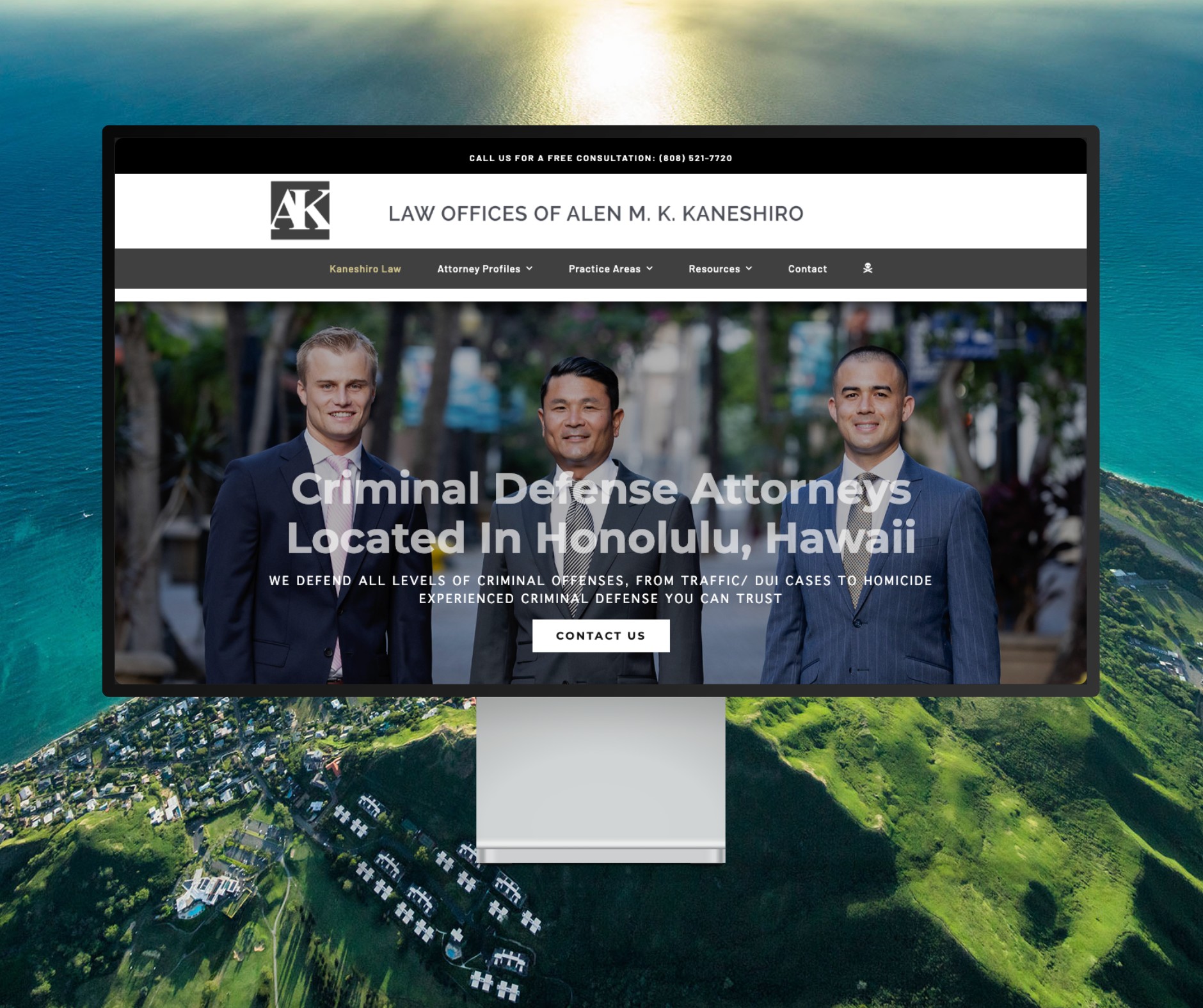
Featured Website: www.kaneshirolaw.com
Kaneshiro Law Firm, one of Hawaii’s most respected legal practices, partnered with The X Digital three years ago for a complete website redesign. Since then, we’ve maintained an ongoing relationship—handling updates, optimizations, and technical support around the clock. Our dedicated team ensures they’re never without assistance, while our enterprise-grade hosting provides 24/7 uptime monitoring and reliability. Kaneshiro Law Firm is one of many long-term clients who trust us to keep their digital presence running flawlessly.