

You’ve seen the headlines. AI can now design entire websites in minutes. Tools promise logos, layouts, and copy with a few prompts. Meanwhile, you’re looking at quotes from human designers that take weeks and cost thousands. It’s tempting to wonder if you even need a person anymore. The truth? AI web design and human web design solve different problems—and knowing which one fits your situation will save you time, money, and a lot of frustration. In this article, we’ll walk through what each approach actually delivers, where they excel, where they fall short, and how to decide which path makes sense for your business right now.
What AI Web Design Actually Does (and Doesn’t Do)
AI web design tools use machine learning to generate layouts, suggest color schemes, write placeholder copy, and even produce basic graphics. You answer a few questions about your business, pick a style, and the system assembles a website framework in minutes. Tools like Wix ADI, Bookmark’s AIDA, and newer GPT-powered builders can create functional pages faster than any human could draft them.
Here’s what AI handles well:
- Speed: You can have a live site in an hour instead of weeks.
- Cost: Most AI builders are subscription-based, often under $30/month with hosting included.
- Templated structure: AI pulls from thousands of existing designs, so you get proven layouts that work on mobile and desktop.
- Basic copy: AI can draft service descriptions, about pages, and CTAs that sound professional enough for a first draft.
But AI web design has clear limits. It doesn’t understand your specific audience, your competitive position, or the nuances of your brand voice. It can’t interview your best customers to learn what objections they had before buying. It won’t notice that your contact form is buried, or that your homepage doesn’t explain what you actually do in the first three seconds. AI builds websites that look like websites—but it doesn’t build strategy, and it doesn’t solve for conversion.
When AI Web Design Works
AI is a solid choice when you need something simple, fast, and cheap. If you’re launching a side project, testing a business idea, or need a placeholder site while you save for a custom build, AI tools get you online without a big upfront investment. They’re also useful for internal tools, event pages, or microsites where the stakes are low and the audience is forgiving.
When AI Web Design Falls Short
AI struggles when your business depends on your website to generate leads, bookings, or sales. It can’t make strategic decisions about what to emphasize, how to structure your service pages for local SEO, or how to guide a visitor from curiosity to contact. If your site needs to compete in a crowded market, rank in search results, or convert cold traffic into paying customers, AI-generated designs usually need significant human intervention to perform.
What Human Web Design Brings to the Table
Human web designers—especially experienced ones—do more than arrange pixels. They ask questions about your business model, your ideal customer, and your goals. They research your competitors, study your analytics, and build a site architecture designed to move specific people toward specific actions. A good designer thinks about load speed, accessibility, mobile behavior, SEO structure, and how every page supports your marketing funnel.
Here’s what human designers deliver that AI can’t:
- Strategic thinking: A designer can tell you that your services page is too vague, your contact form asks for too much information, or your homepage buries the lead.
- Custom solutions: If your business has unique workflows, booking systems, or product configurations, a human can build exactly what you need instead of forcing you into a template.
- Brand nuance: Humans understand tone, voice, and the subtle differences that make your brand feel distinct instead of generic.
- Conversion focus: Designers with real-world experience know how to structure pages so visitors take action—whether that’s filling out a form, calling, or buying.
- Long-term partnership: A designer who understands your business can evolve your site over time as your needs change, instead of starting from scratch every time.
In our 20+ years building websites, we’ve seen the same pattern: businesses that treat their site as a revenue channel invest in human design. Businesses that treat it as a digital brochure often start with AI or cheap templates and upgrade later when they realize what they’re leaving on the table.
The Hybrid Approach: AI as a Tool, Not a Replacement
The smartest path forward isn’t choosing AI or human—it’s using AI as a tool inside a human-led process. Professional designers already use AI for drafting copy, generating image variations, speeding up code, and testing layout ideas. The difference is that a human makes the final decisions based on strategy, not algorithms.
For example, we use AI to help generate blog content through our tool Zao Flo, but every article is reviewed, edited, and optimized by someone who understands SEO and our clients’ audiences. AI handles repetition and speed; humans handle judgment and strategy. That combination is faster and cheaper than purely manual work, but far more effective than purely automated output.
If you’re a small business owner, you can apply the same thinking. Use AI to draft your homepage copy, then hire a copywriter to refine it. Use an AI builder to mock up a layout, then bring in a designer to customize it for your brand. Use AI to generate blog post outlines, then write or edit them yourself. You get speed and cost savings without sacrificing quality.
How to Decide Which Path Fits Your Business
Start by asking yourself three questions:
1. Does your website need to generate revenue, or just exist?
If your site is a lead-generation tool, an e-commerce store, or a booking platform, invest in human design. If it’s an online business card or a placeholder, AI is fine.
2. Do you have a clear brand and message, or are you still figuring it out?
If your positioning, voice, and value proposition are solid, a human designer can execute them. If you’re still experimenting, AI lets you test cheaply before committing to custom work.
3. How much time and money are you willing to invest upfront?
AI is faster and cheaper in the short term. Human design costs more upfront but often pays for itself in better conversion rates, SEO performance, and fewer rebuilds down the road.
Here’s a simple decision guide:
- Choose AI if: You need a site in days, your budget is under $500, and your business model is simple.
- Choose human design if: Your website is a core revenue driver, you’re in a competitive market, or you need custom functionality.
- Choose hybrid if: You want speed and cost savings but also need strategic thinking—use AI for drafts and templates, then hire a pro to refine and optimize.
Getting Started: What to Do Next
If you decide AI is the right starting point, pick a tool that fits your technical comfort level. Wix, Squarespace, and Shopify all have AI-assisted builders that work well for straightforward sites. Spend time on your copy—AI-generated text is generic, so rewrite it in your own voice. And plan to revisit your site in six months. If your business grows, you’ll likely outgrow the template.
If you’re ready for human design, start by clarifying your goals. What do you want your website to do? Who is your ideal customer? What action should they take? A good designer will ask these questions anyway, but having answers ready makes the process faster and more focused. And if you’re not sure whether you need a full redesign or just targeted fixes, request a site review—most experienced agencies (including ours) will tell you honestly what’s worth spending money on.
Not sure which path fits your business? We’ve built hundreds of websites over two decades, and we’ve also helped clients figure out when they don’t need us yet. Request a free website review and we’ll tell you exactly what we’d fix first—and whether AI, human design, or a hybrid approach makes the most sense for where you are right now.
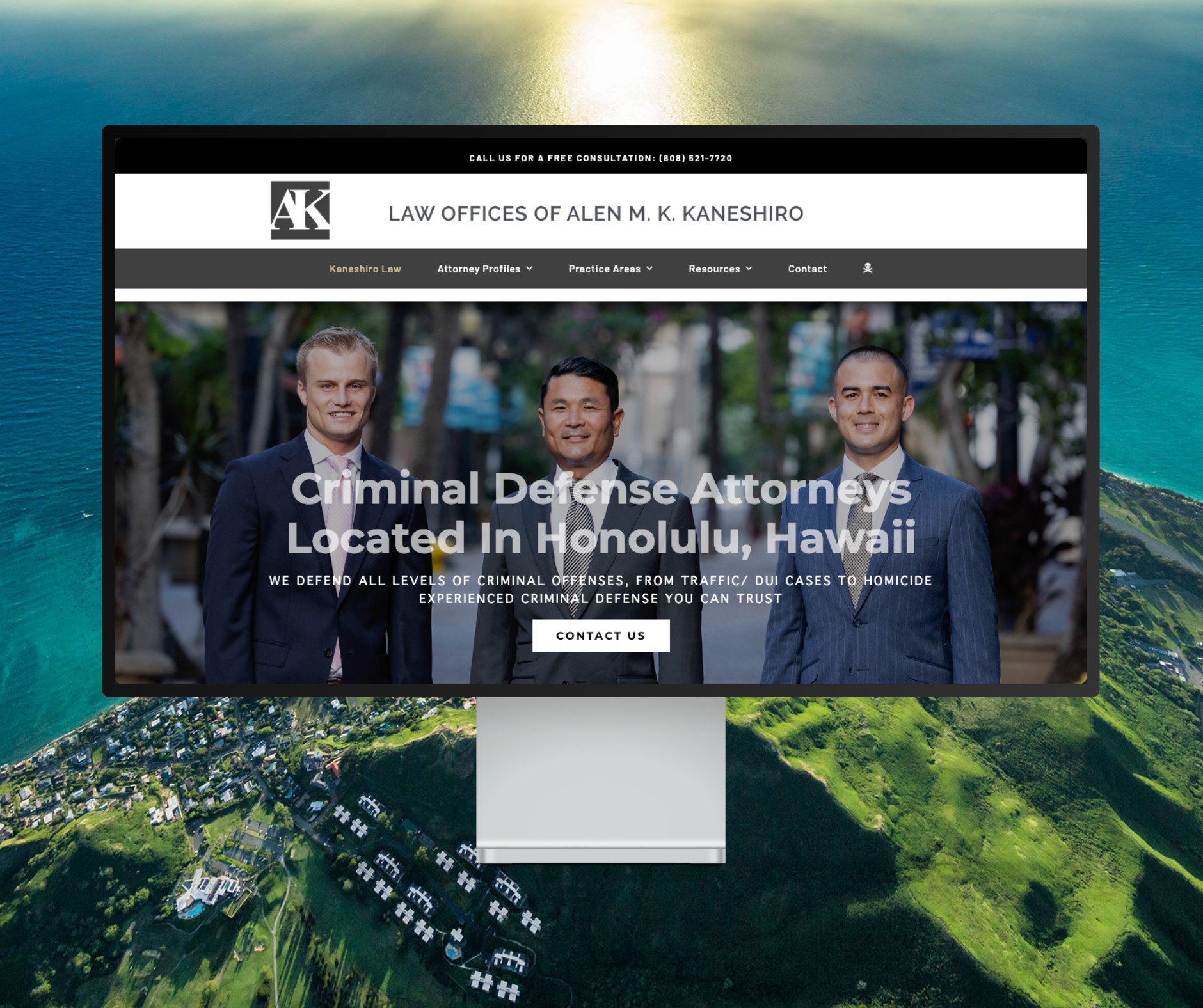
Featured Website: www.kaneshirolaw.com
Kaneshiro Law Firm, one of Hawaii’s most respected legal practices, partnered with The X Digital three years ago for a complete website redesign. Since then, we’ve maintained an ongoing relationship—handling updates, optimizations, and technical support around the clock. Our dedicated team ensures they’re never without assistance, while our enterprise-grade hosting provides 24/7 uptime monitoring and reliability. Kaneshiro Law Firm is one of many long-term clients who trust us to keep their digital presence running flawlessly.