

You’ve probably looked at a dozen web design agency websites by now. Some show stunning portfolios full of sleek layouts and bold colors. Others lead with low prices or fast turnaround times. A few promise “affordable websites starting at $999.” And you’re stuck wondering: which signal actually matters?
Here’s what we’ve learned after building more than 1,000 websites over 20 years: the portfolio tells you whether an agency can solve your problem, and price only tells you what you’ll pay. Those two things aren’t the same. A beautiful $3,000 website that doesn’t convert visitors into leads is a worse investment than a $15,000 site that pays for itself in three months. When you’re choosing a web design agency, the portfolio isn’t just eye candy—it’s the most reliable predictor of whether your project will actually work.
This guide walks you through exactly how to evaluate a web design agency portfolio, what red flags to watch for, and why leading with price almost always backfires. We’ll also show you what questions to ask before you sign anything, and how to spot the difference between agencies that build websites and agencies that build businesses.
Why Most Business Owners Evaluate Portfolios Wrong
The biggest mistake we see business owners make is judging a portfolio the same way they’d judge art in a gallery. They look at visual style, color choices, and whether the design feels “modern” or “clean.” That’s not wrong—it’s just incomplete. A portfolio screenshot tells you what a site looked like on launch day. It doesn’t tell you whether it loaded fast, ranked in search, converted visitors, or stayed online without breaking.
According to research cited by trajectorywebdesign.com, the most common portfolio evaluation error is focusing on aesthetics instead of strategic thinking. When reviewing agency work, you need to ask different questions:
- Is the messaging clear? Can you tell what the company does within five seconds of landing on the homepage?
- Is the user experience intuitive? Does the navigation make sense? Can you find what you’d be looking for if you were a potential customer?
- Is there a clear conversion path? Are there calls to action that guide visitors toward a next step, or does the site just look nice without asking anyone to do anything?
- Does it work on mobile? Pull up the portfolio sites on your phone. Responsive design is table stakes in 2026, but many agency portfolio pieces still break on mobile devices.
We’ve rebuilt dozens of websites that looked great but generated zero leads. In every case, the original agency optimized for the wrong outcome. They designed for awards, not revenue. When you evaluate a portfolio, you’re not hiring a designer—you’re hiring a problem solver. The portfolio should prove they understand your type of problem.
What a Strong Portfolio Actually Shows You
A portfolio organized around results, not just aesthetics, tells you three things immediately. First, it shows you the range of industries the agency has worked in and whether they’ve solved problems similar to yours. Second, it reveals whether they think in terms of business outcomes or just visual design. Third, it demonstrates whether they can explain their work in plain English or hide behind jargon.
Look for portfolios that include context: client names, industry labels, project scope, and brief descriptions of what the work accomplished. As trajectorywebdesign.com points out, the best portfolios group projects with clear framing so you can evaluate strategic thinking, not just visual taste.
At The X Digital, we organize our case studies around outcomes. For example, our work with Maui Cruisers isn’t just a portfolio piece—it’s a story about taking a car rental company from invisible in search to ranking in the top three across all of Maui. The site generates 10 to 20 qualified leads per day and 5 to 10 phone calls daily from high-intent customers. That’s what a portfolio should prove: not that the agency can make something pretty, but that they can make something work.
How to Choose a Web Design Agency Based on Portfolio Quality
Once you understand what to look for, the evaluation process becomes straightforward. Start by identifying three to five agencies whose portfolios include work in your industry or for businesses with similar goals. Then verify the work is real and still live.
HyberX recommends checking live sites, not portfolio screenshots. Open the URLs on your phone. Check load speed using Google PageSpeed Insights. View the page source. A portfolio image proves nothing shipped. If an agency lists a project but the site is offline, redesigned by someone else, or performing poorly, that tells you something important about their follow-through.
The Five Questions That Filter 80% of Agencies
According to designkey.studio, five questions on the first call filter out most agencies that aren’t a fit:
- Can you show me three live sites you built for businesses like mine? If they can’t, they’re learning on your dime.
- What happens after launch? Do they offer hosting, maintenance, and ongoing optimization, or do they hand you the keys and disappear?
- Who actually does the work? Get names, roles, and locations. If the work is subcontracted overseas, you need to know upfront.
- How do you measure success? If they talk only about design awards or “user engagement” without mentioning leads, sales, or search rankings, they’re optimizing for the wrong goal.
- What’s included in the price? A $5,000 quote that includes hosting, SSL, copywriting, and six months of support is different from a $5,000 quote that covers design only.
We ask clients these same questions in reverse during discovery. If a business owner can’t articulate what success looks like—more calls, more bookings, more product sales—we help them define it before we start designing. That clarity is what separates projects that succeed from projects that just launch.
Red Flags That Disqualify an Agency Immediately
HyberX identifies three red flags that should end the conversation immediately. First, a portfolio you can’t verify with live URLs. Screenshots are cheap, and stock mockups are everywhere. If the agency can’t point to five sites currently in production, ask why.
Second, guaranteed rankings. Nobody controls search results, and an agency promising a number one position is either misinformed or counting on you not checking. We’ve spent years building SEO strategies that consistently achieve 95%+ performance scores and long-term traffic growth, but we never guarantee a specific ranking because Google doesn’t work that way.
Third, refusing to give you admin access to your own hosting, domain, or analytics. That’s not a technical constraint—it’s a bargaining chip, and it will cost you later. Every site we build lives in the client’s accounts. You own the code, the domain, the hosting, and the data. Always.
Why Price Is the Worst First Filter
We understand the temptation to lead with budget. You want to know what things cost before you invest time in conversations. But filtering agencies by price before you understand scope is like hiring a contractor based on their hourly rate before you know whether they’re building a deck or a house.
HyberX breaks down typical agency costs across the US in 2026. A small business site with 5 to 10 pages typically runs $3,000 to $12,000 and takes 3 to 6 weeks. A custom marketing site with 15 to 30 pages, including research and integrations, costs $15,000 to $50,000 and takes 8 to 16 weeks. Custom e-commerce or headless builds start at $40,000 and can exceed $150,000 depending on complexity.
Those ranges are wide because scope varies dramatically. A $3,000 website might be a templated WordPress build with stock photos and placeholder copy. A $30,000 website might include custom design, professional photography, original copywriting, advanced integrations, and a year of managed hosting. Price by itself tells you very little. Price against scope tells you plenty.
What You Actually Get at Different Price Points
At the low end—$1,500 to $5,000—you’re typically getting a semi-custom build using a premium theme, minimal copywriting, and basic SEO setup. This works if you have a simple offer, clear messaging, and you’re comfortable managing your own hosting and updates. It doesn’t work if you need strategy, custom functionality, or ongoing optimization.
At the mid range—$10,000 to $30,000—you’re getting custom design, strategic messaging, professional copywriting, integrations with your CRM or booking system, and usually some level of post-launch support. This is where most small to mid-sized businesses should be shopping if their website is a real revenue channel.
At the high end—$40,000 and up—you’re getting a fully custom build, often on a headless CMS or e-commerce platform, with advanced functionality, extensive content creation, and a long-term optimization plan. This makes sense for businesses doing significant revenue online or competing in crowded markets where performance and user experience are competitive advantages.
We’ve delivered projects across all three ranges. The deciding factor isn’t the budget—it’s whether the scope matches the business goal. A $5,000 site that generates 50 leads a month is a better investment than a $50,000 site that generates five.
What to Ask Before You Sign Anything
Once you’ve narrowed your list to two or three agencies whose portfolios prove they can do the work, the final decision comes down to process, ownership, and partnership fit. HyberX recommends a nine-point checklist before you commit:
- Write a one-page brief with your goals, current traffic, page count, must-have integrations, launch date, and budget range. Share the budget—withholding it just gets you three quotes you can’t compare.
- Shortlist four to six agencies, including at least one local, one national, and one specialist in your industry or platform.
- Check live sites, not portfolio screenshots. Open the URLs on your phone and check load speed.
- Ask who does the work—names, roles, location, and whether any of it is subcontracted.
- Ask for the process document showing discovery, wireframes, design, build, QA, and launch, with revision rounds counted.
- Ask two references from projects that launched 12 or more months ago. Old clients tell you about support quality.
- Compare proposals on scope, not on the total. Line items reveal what someone quietly excluded.
- Confirm ownership in writing: code, domain, hosting, analytics, design files—all in your accounts.
- Start small if you can. A landing page or content sprint tells you more about a team than any pitch deck.
At The X Digital, we manage hosting, performance, and support after launch because we believe a website is never really done. Launch day isn’t the finish line. The businesses that get the best return are the ones that treat their website as a system that needs tuning, not a project that gets checked off a list.
Why We Built Our Business Around Long-Term Partnerships
We’ve been doing this for more than 20 years, and we’ve worked with over 100 active clients at any given time. What we’ve learned is that the best outcomes happen when the relationship outlasts the launch. A website that ranks, converts, and grows revenue doesn’t get there in 90 days. It gets there through iteration, optimization, and continuous improvement.
That’s why we host what we build. Every site we deliver runs on our managed infrastructure, which means we’re responsible for speed, security, uptime, and performance—not just how it looked on launch day. When something breaks, you’re not calling a support line. You’re texting the same team that built the site.
Our case study with Maui Cruisers shows what this looks like in practice. We handle everything: hosting, maintenance, complete branding overhaul, website redesign, and ongoing optimization. Their new site scores above 90% performance, loads lightning-fast, and runs on autopilot. The client simply pays us and focuses on their business. They’re now ranked in the top three car rental companies across all of Maui, generating consistent leads and phone calls every single day.
That’s the outcome a strong portfolio predicts. Not a beautiful website that wins awards. A website that works, grows, and pays for itself many times over.
Ready to Choose the Right Agency?
Choosing a web design agency based on portfolio quality instead of price takes more work upfront, but it’s the only reliable way to predict whether your project will succeed. Look for live sites that prove the agency can solve problems like yours. Ask who does the work, what happens after launch, and how they measure success. Verify ownership, compare scope, and check references from clients who launched more than a year ago.
If you’re a small or mid-sized business owner whose website is a real revenue channel—not just a brochure—we’d be happy to show you what we’ve built and talk through what makes sense for your business. Whether your project is a $5,000 build or a $50,000 build, you’ll get the same level of attention and the same long-term support. We stay in constant communication throughout, and we don’t disappear after launch.
Visit thexdigital.com to see our portfolio, read more case studies, or schedule a discovery call. Let’s build something that actually works.
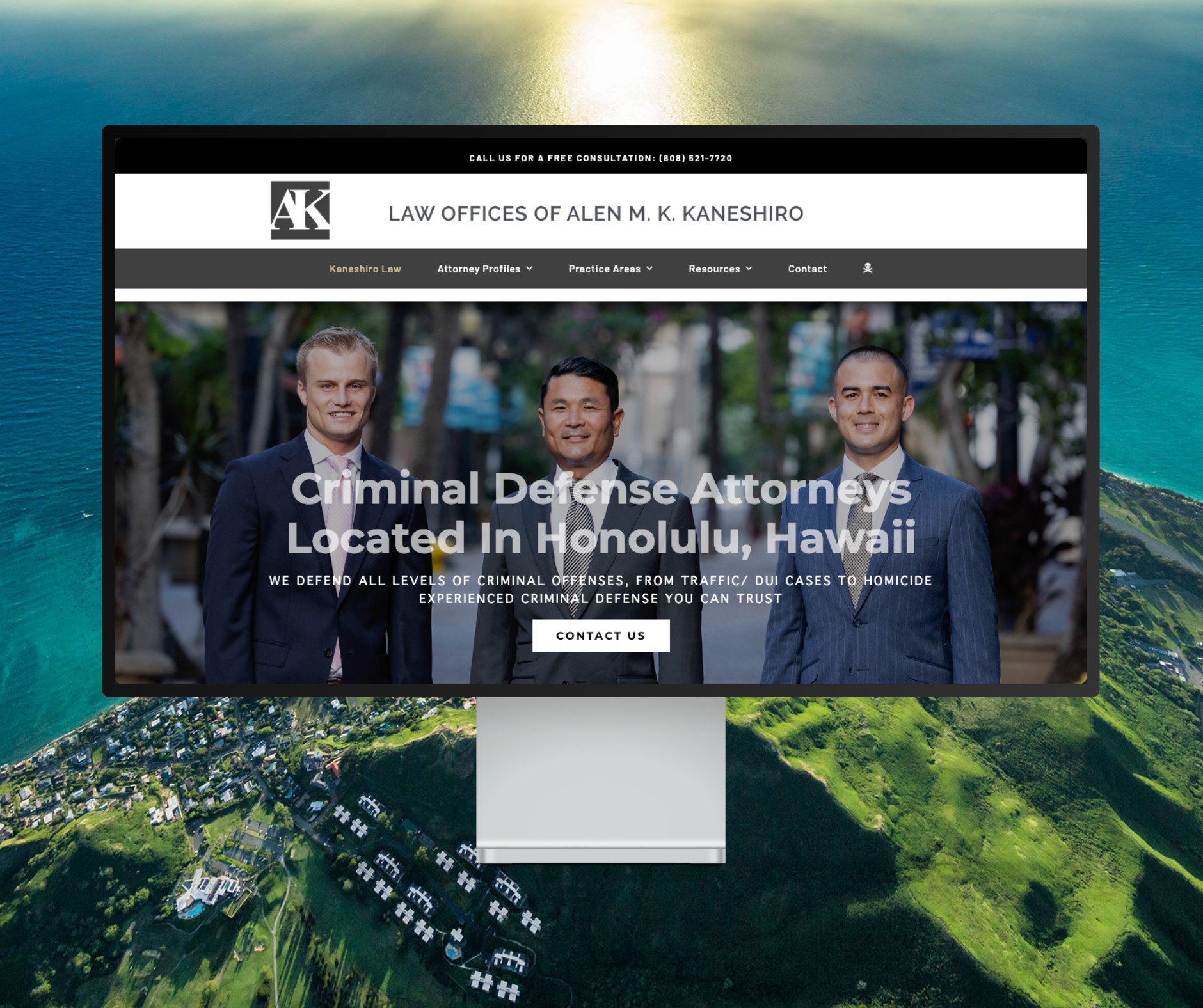
Featured Website: www.kaneshirolaw.com
Kaneshiro Law Firm, one of Hawaii’s most respected legal practices, partnered with The X Digital three years ago for a complete website redesign. Since then, we’ve maintained an ongoing relationship—handling updates, optimizations, and technical support around the clock. Our dedicated team ensures they’re never without assistance, while our enterprise-grade hosting provides 24/7 uptime monitoring and reliability. Kaneshiro Law Firm is one of many long-term clients who trust us to keep their digital presence running flawlessly.