

Most small business owners who start shopping for an AI app end up comparing apples to forklifts. One agency quotes $4,000 for a chatbot widget. Another quotes $60,000 for a “full AI platform.” A third sends a proposal that’s mostly stock photos and the word “innovation.” None of them asked what the app actually has to do. That’s the tell.
Here’s the uncomfortable truth: the production side of building software got dramatically faster, but the decisions, the content, and the approvals did not. In Stack Overflow’s 2026 Developer Survey of more than 30,000 developers, 73% of those using AI coding assistants use them daily. Code is cheap now. Judgment isn’t. So when you choose a web design agency for a small business AI app, you’re not really buying typing speed — you’re buying someone who can scope the problem, wire it to your business, and keep it running after launch.
This guide walks through how to define what your AI app actually is, the questions that separate real builders from resellers, what “web design for AI app” projects get wrong about search visibility, and the ownership and cost traps that surface six months in.
Before You Choose a Web Design Agency, Define What Your AI App Actually Does
The single biggest reason AI app development projects blow up is that nobody wrote down what “AI” meant. The word covers a $200-a-month chatbot and a $200,000 platform. If you can’t describe your project in one sentence — who uses it, what it does, and what happens when it works — no honest agency can price it.
The four kinds of AI projects small businesses actually buy
- An AI assistant on your existing site. A chat widget that answers common questions, qualifies leads, and hands off to a human. Usually the fastest ROI and the cheapest entry point.
- An AI-powered web app. A logged-in tool your customers use — a booking engine that handles complex availability, a quote calculator, a client portal that summarizes documents.
- A mobile app with AI features. Native or cross-platform, typically for repeat customers, field staff, or rental and tourism businesses where people are on their phones.
- An automation layer behind the scenes. AI that drafts content, responds to reviews, sorts inbound email, or generates reports. Nobody sees it, but it removes hours of admin every week.
Each one has a completely different build path, a different maintenance burden, and a different price. A proposal that doesn’t name which of these you’re getting is a guess — and the guess is never in your favor.
Scope first, then a firm number
A fair price comes from a short paid discovery that defines the functionality, followed by a fixed number for that defined scope. You should be paying for thinking, engineering, testing, and accountability. You should not be paying 2026 prices for production work that machines now handle in an afternoon. If an agency quotes you before asking what the site has to do, walk. If they quote sixteen weeks and can’t explain what happens in week nine, the honest answer is usually “waiting on content.”
Questions That Separate Real AI App Builders From Resellers
Plenty of agencies now list “AI” on their services page because they connected a third-party chatbot to a WordPress site once. That’s a legitimate service — but it isn’t AI app development, and it shouldn’t be priced like it. These questions sort the two out quickly.
Ask every agency these nine things
- Show me a live app or site you built that ranks on page one or gets cited in AI answers. What specifically did you do?
- How do you structure a page so an AI assistant can quote it accurately?
- Which parts of my project are custom code, which are plugins, and which are outside services? Who maintains each one?
- Where does AI speed up your process, and where does that show up in my price and timeline?
- What’s your plan to protect my current rankings and traffic during a rebuild?
- Who owns the domain, hosting, code, and content when we’re done?
- What happens when I want a change that isn’t in scope?
- Who is my point of contact, and will I actually talk to the people doing the work?
- After launch, how does my team update the app, and how long does a simple change take?
Red flags worth ending the conversation over
Any one of these is a reason to keep shopping:
- They can’t open a live site they built and show you the structured data on it — or explain what it says.
- They own your domain, your hosting, or your code. Or the app only runs on a builder you can’t leave.
- “Our AI will write all your content,” with no plan for who fact-checks it. Google is blunt about this: it’s critical to manually fact-check and review AI-generated content for accuracy before publishing.
- A price with no discovery behind it, or a timeline nobody can explain.
- You never meet the designer or developer who’ll do the work.
Notice that none of these are about price. Cheap agencies and expensive agencies both fail in these exact ways.
Web Design for AI App Success: The Layer Machines Read
Every website and app has two layers. The visual layer is what a person sees. The information layer is what a machine reads: the text in the page’s code, the headings and how they nest, the structured data labeling your business and services, and whether your name, address, and phone number match your Google Business Profile. A beautiful visual layer sitting on a muddled information layer is a billboard facing a wall.
This matters more than it did two years ago because your site has a second reader now. Google’s AI Overviews, ChatGPT, Copilot, and Perplexity read your pages and answer questions about you — often without sending the person to your site at all. In a field experiment run in January and February 2026, researchers at the Indian School of Business and Carnegie Mellon randomly showed more than a thousand people Google results with and without AI Overviews. When an Overview appeared, clicks to regular results fell 39.8%, and searches ending without a single click rose 34.5%. Across 101,574 websites tracked by SE Ranking, AI assistants sent 0.32% of all visits in early 2026 — small, but sixteen times their 2024 share.
The practical checklist for an AI-readable build
- Important information lives in real text, not inside images or tabs that may never get read.
- Every page is broken into clearly headed sections that each answer one question.
- Facts are labeled with structured data — Organization, Service, FAQPage — matching what’s visible on the page.
- Proof is written in text: the client, the problem, what was done, what changed. Not a logo carousel.
- Pages load fast. Only about 55.9% of websites passed Google’s Core Web Vitals thresholds as of May 2026, which means most of your competitors are still slow.
And no, SEO isn’t dead. Google states there are no additional requirements to appear in AI Overviews or AI Mode — the page simply has to be indexed and eligible to show in Search with a snippet. That’s not a loophole; it’s a foundation. Skip it and there’s nothing for AI visibility to sit on. Google’s own guidance on helpful content still applies.
Why your app and your website have to agree
If your new AI booking app lives at app.yourbusiness.com but your website still describes last year’s pricing, you’ve built two versions of the truth. Assistants will quote the wrong one. Insist that whoever builds the app also reconciles the website, the Google Business Profile, and the structured data in the same project.
Ownership, Hosting, and the Costs Nobody Quotes Up Front
AI apps have a cost structure that traditional websites don’t, and this is where small business owners get surprised. Every AI feature that calls a model — OpenAI, Anthropic, Google — costs money per use. Someone has to own that API key, set spending limits, and monitor it.
Get these in writing before you sign
- Ownership. You own the domain, the hosting account, the code repository, and the content. Full stop.
- Model costs. Who pays for API usage, what the monthly ceiling is, and what happens if usage triples.
- Data handling. What customer data leaves your systems, where it goes, and whether it’s used for training.
- Maintenance. AI features break when models are deprecated or pricing changes. Ask who monitors that.
- Hosting and uptime. Who’s on call when the app goes down on a Saturday.
We host more than 100 client sites on our own managed infrastructure, and we build our own AI products, so we’ll say this plainly: an agency that won’t take responsibility for speed, security, and uptime after launch isn’t finished building. Launch day is the midpoint, not the finish line.
Conclusion: Hire for Judgment, Not for the Word “AI”
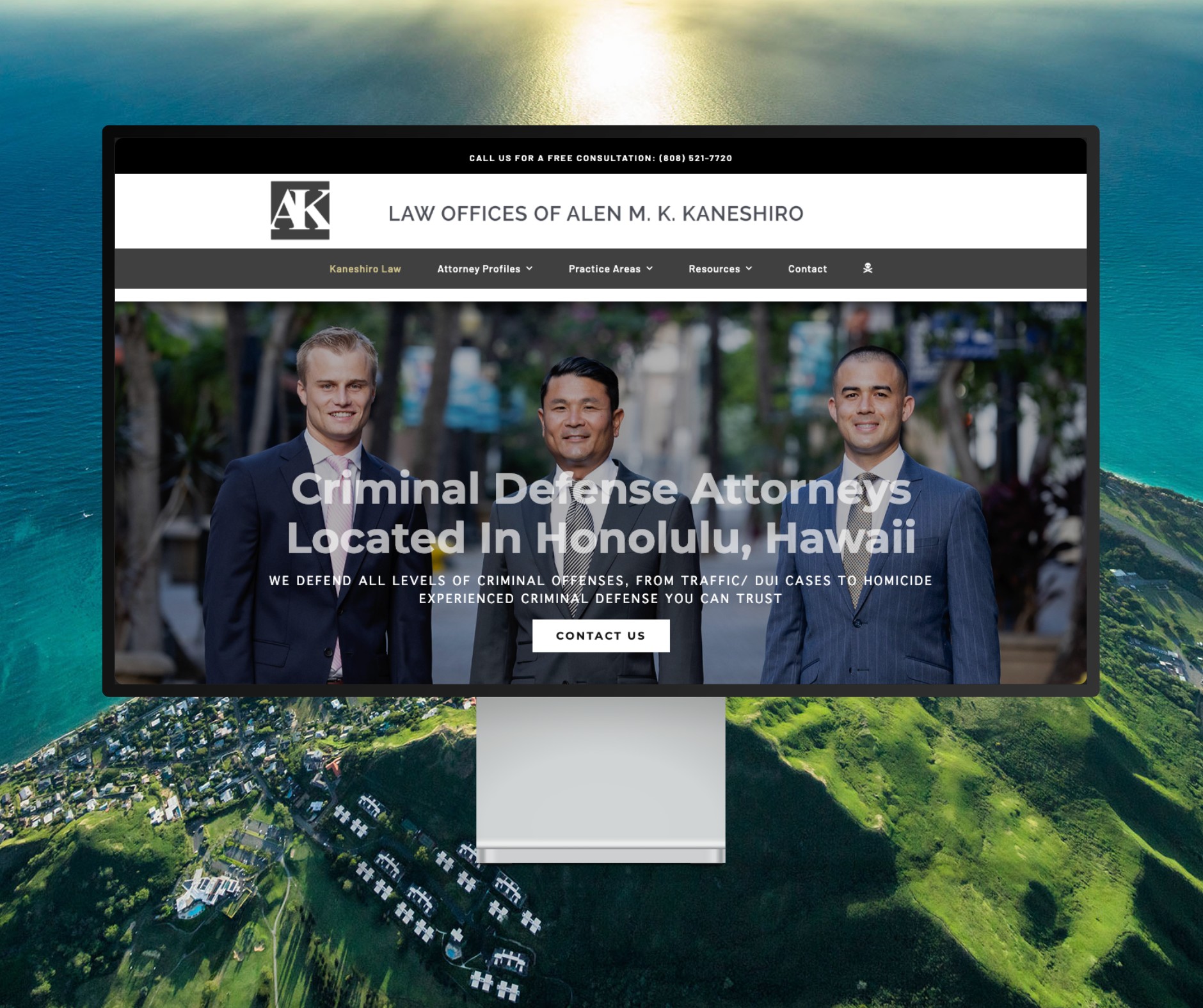
Featured Website: www.kaneshirolaw.com
Kaneshiro Law Firm, one of Hawaii’s most respected legal practices, partnered with The X Digital three years ago for a complete website redesign. Since then, we’ve maintained an ongoing relationship—handling updates, optimizations, and technical support around the clock. Our dedicated team ensures they’re never without assistance, while our enterprise-grade hosting provides 24/7 uptime monitoring and reliability. Kaneshiro Law Firm is one of many long-term clients who trust us to keep their digital presence running flawlessly.