

Ask ten business owners what a website costs and you’ll get ten different answers — and none of them will be entirely wrong. That’s the frustrating part. The small business website cost conversation is full of numbers that sound authoritative but describe completely different things. A template someone dragged together over a weekend, a five-page brochure site from a freelancer, and a custom WordPress build with copywriting, booking integrations, and a real SEO foundation are not the same product, so they don’t share a price tag.
In this breakdown, we’ll walk through what things actually cost in 2026 using published survey data instead of guesses. You’ll see the main build paths side by side, the ongoing expenses most quotes conveniently leave out, and the questions that separate a real estimate from a lowball. We’ve built, repaired, and hosted hundreds of sites over the last two decades, so we’ll also tell you where you can honestly save money — and where cutting corners quietly costs you more six months later.
So What Does a Small Business Website Cost in 2026?
Here’s the short answer: most professional small business websites land somewhere between $3,000 and $15,000. That range isn’t a cop-out — it’s what the data shows. In the Clutch 2026 survey, 61% of small businesses spent under $10,000 on their most recent website, and GoodFirms’ 2026 software development survey found 51.6% of web development agencies quoting $3,000 to $15,000 for small-scale sites, according to SiteGround’s 2026 cost breakdown.
At the low end, a simple, professionally built site for a local service business often runs $500 to $3,000, while larger custom builds with branding, dozens of pages, or e-commerce climb from $5,000 to $20,000 and beyond, as PageSimple’s small business website cost guide outlines. Meanwhile, a bare-bones DIY site can cost as little as $145 to $640 a year in domain, hosting, and builder fees — you’re just paying in hours instead of dollars.
The main build paths, side by side
- DIY website builder (Wix, Squarespace): roughly $16 to $50 per month. Fast and cheap, but you build it, maintain it, and live with the template’s limits.
- AI website builder: free to about $50 per month. Good for a quick first version; output quality varies and a custom domain usually requires a paid plan.
- Self-hosted WordPress, DIY: $100 to $500 per year in hosting and a premium theme. More flexible, slightly more technical.
- Freelancer: $1,500 to $8,000 one-time for a custom-designed site, with turnaround and post-launch support being the wild cards.
- Boutique studio or full agency: $6,000 to $35,000 and up, typically including strategy, custom design, content, and ongoing support.
Why two quotes for the same site can differ by $10,000
Because they’re rarely quoting the same work. A $3,000 freelancer and a $12,000 agency might both say “five-page website,” but one number may include copywriting, photography, SEO setup, and 30 days of post-launch support while the other bills every one of those separately. Before you compare a single figure, write down exactly what you need and check each proposal against that same list. Apples to apples is the only comparison that means anything.
The Costs That Never Show Up in the Quote
This is where budgets quietly break. The build price is the headline; ownership is the real story. Two sites can both cost $1,000 to build and be wildly different things to own — one with $5 a month in ongoing costs, the other with $200 a month in required software subscriptions.
Domain, hosting, and maintenance
Your domain should be registered in your name, on your account, and you should know who renews it. That’s a $15-a-year detail that becomes a hostage situation if your developer owns it. Hosting for a simple brochure site can run $5 to $15 a month on shared plans, or $30 to $75 a month for managed WordPress hosting that handles security, updates, and backups. If you’re running WordPress, maintenance isn’t optional — plugins and core files need patching, and a maintenance plan typically runs $50 to $200 per month, per Elementor’s 2026 small business website cost analysis.
For a small business site, total annual ownership usually lands between $600 and $6,000, with full-service care plans commonly priced at $95 to $195 per month. If you’re comfortable handling updates yourself, you can run a simple site for well under $100 a year in hard costs — but you’re paying in hours, and one missed security patch can undo years of savings.
Content, photography, and the software stack
Words and images are the two things that most often get cut from a quote and then added back later at a premium. Professional copywriting and a half-day photo shoot can add a few thousand dollars to a project — or you can supply both yourself and save real money. Neither choice is wrong; going in blind is.
Then there’s the software layer. Booking systems, form tools, email platforms, CRMs, and analytics can add $0 or $300 a month depending on how many you stack. Ask what’s actually required versus nice to have. A local service business doesn’t need infrastructure that looks like Netflix.
Website Design Pricing: What You Actually Get at Each Level
Website design pricing tracks effort, not page count. A five-page site with custom strategy and copy takes more work than a fifteen-page site assembled from a template — and it usually performs better, because someone thought about what each page is supposed to accomplish.
DIY and AI builders: when they’re genuinely the right call
We’ll say it plainly: if you’re a brand-new business with a tight budget and a simple story to tell, a builder can get you live for a few hundred dollars a year. That’s a legitimate starting point. What you’re trading away is customization, speed, and search performance — and you’re committing to doing the work yourself. AI builders have narrowed the gap, but the output still needs a human editor, and publishing on a custom domain almost always requires a paid tier.
Freelancers versus agencies
A good freelancer is a smart choice for a straightforward brochure site: $2,000 to $8,000 for a custom-designed WordPress build is a normal, fair range. The trade-offs are turnaround time, backup capacity, and what happens after launch when something breaks at 9 p.m. before a holiday weekend.
An agency costs more — $10,000 to $35,000 for a custom small business site, with e-commerce starting around $20,000 — because you’re buying strategy, design, development, content, and a team that’s still there next year. The honest version: if your website is a real revenue channel rather than a digital business card, the agency path usually pays for itself. If it isn’t, don’t buy one.
How to Set a Website Budget You Won’t Regret
Start with what the site needs to do, not what it should look like. Then build the budget around three buckets: build, launch, and own. A rough guide is to budget an extra 10–20% above the quoted build price for the things that inevitably appear — stock photography, premium plugins, professional email, and the first few months of care.
Before you sign anything, get clear answers to these questions:
- Who owns the domain, the hosting account, and the code — and can I take them with me?
- What’s included in the price, line by line: copy, photos, SEO setup, revisions, training?
- What does a change cost after launch — a phone number update, a new service page, a photo swap?
- Which software subscriptions are required, and who pays for them?
- What happens if the site breaks, gets hacked, or goes down? Who fixes it, and how fast?
- Is there a maintenance plan, what does it cover, and what’s the monthly cost?
If a provider can’t answer those six questions in writing, that’s your answer. The cheapest quote in the room is rarely the cheapest website to own.
Conclusion
The realistic range for a small business website in 2026 is wide because the work is genuinely different at each level: a few hundred dollars a year for a DIY build, $3,000 to $15,000 for most professionally built small business sites, and $20,000 and up once you’re building real business infrastructure. What matters isn’t hitting a specific number — it’s matching the spend to what the site needs to do for your revenue.
Our advice after twenty years of building these: spend less on decoration, more on speed, structure, and content that answers real customer questions. Those are the things that keep earning after launch. And always budget for ownership, not just the build — the site you can’t maintain is the site that quietly stops working.
If you’re weighing a quote right now and something feels off — too cheap, too vague, or too much jargon — we’re happy to look at it with you and tell you honestly whether it’s a fair number. No pitch, no pressure. Sometimes the most useful thing we do is tell a business owner they don’t need to spend the money yet.
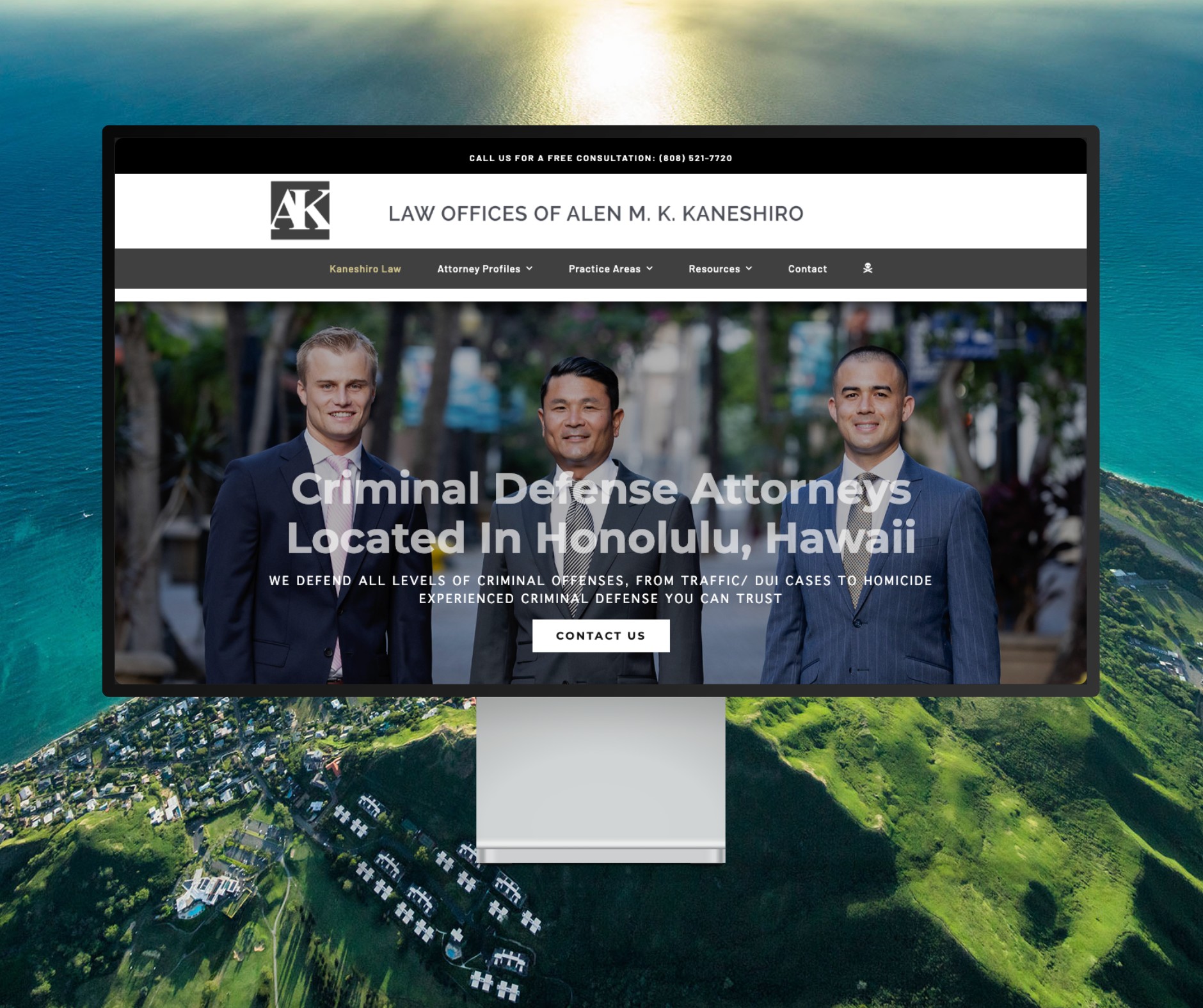
Featured Website: www.kaneshirolaw.com
Kaneshiro Law Firm, one of Hawaii’s most respected legal practices, partnered with The X Digital three years ago for a complete website redesign. Since then, we’ve maintained an ongoing relationship—handling updates, optimizations, and technical support around the clock. Our dedicated team ensures they’re never without assistance, while our enterprise-grade hosting provides 24/7 uptime monitoring and reliability. Kaneshiro Law Firm is one of many long-term clients who trust us to keep their digital presence running flawlessly.