

Building trust with your website’s content is one of the most practical ways to turn visitors into customers. People may find your business through Google, an AI answer engine, a referral, or a paid advertisement, but they still need a reason to believe you can solve their problem. A polished design helps, but trustworthy website content does the heavier work: it answers questions, sets expectations, demonstrates experience, and makes the next step feel safe.
That matters especially for small and mid-sized businesses. When someone is choosing a contractor, booking a rental, buying a product, or contacting a professional service provider, they are often comparing several options at once. Your content needs to show why you are credible without sounding exaggerated or overly sales-focused.
In this guide, we’ll explain how to build content credibility, improve user engagement, support stronger SEO rankings, and use content as part of your conversion optimization strategy. These are not complicated tricks. They are straightforward habits that help your website communicate like a knowledgeable, honest business.
Why Building Trust with Your Website’s Content Matters
Your website is often the first meaningful interaction a potential customer has with your business. Before they call, submit a form, visit your location, or place an order, they are looking for signals that you understand their needs and will deliver what you promise.
Trust reduces uncertainty. A visitor may be asking:
- Have you helped people with a problem like mine?
- Are your prices, process, and service area clear?
- Can I verify that your business is legitimate?
- What happens after I contact you?
- Will the quality of your work match your claims?
Strong content answers these questions before a salesperson ever gets involved. It also helps the right visitors qualify themselves. Someone who understands your process, availability, and typical pricing range is more likely to become a productive lead than someone who has only seen a vague headline and a “Contact Us” button.
Trust affects search and conversions
Search engines aim to provide useful results from credible sources. While there is no single “trust score” that guarantees rankings, helpful, accurate, well-organized content can support SEO performance. It gives search engines more context about your services and gives readers a reason to stay, explore, and return.
That behavior can support improving user engagement, although engagement metrics should not be treated as a magic ranking formula. More importantly, useful content helps people make decisions. A page that earns a visitor’s confidence is more valuable than one that attracts traffic but produces no calls, purchases, or inquiries.
Trust is built through consistency
Trust rarely comes from one impressive paragraph. It develops through consistent details across your website. Your service pages, about page, reviews, contact information, policies, images, and follow-up process should all tell the same story.
If your homepage says you provide fast service but your contact form promises a response within five business days, visitors may hesitate. If you claim to be local but provide no address, team information, or service-area details, people may question the claim. Credibility is often won or lost in these small moments.
Write Clear, Specific Content Your Customers Can Believe
Vague marketing language is one of the fastest ways to weaken trust. Phrases such as “best in town,” “world-class service,” and “unbeatable quality” may sound positive, but they do not give readers useful evidence. Specific content is more persuasive because it helps people understand what you actually do.
Replace broad claims with proof
Instead of saying you provide “exceptional service,” explain what that means. You might describe your response time, project workflow, warranty, materials, qualifications, or quality-control process. A home service company could explain how estimates work, what customers should prepare before an appointment, and which situations require an emergency call.
For an e-commerce business, useful details might include sizing guidance, shipping timelines, product materials, care instructions, and return conditions. For a professional service provider, explain who the service is for, what the engagement includes, and what outcomes are realistic.
Specificity does not require revealing confidential information or making aggressive promises. It simply means replacing empty adjectives with facts that help a prospective customer decide.
Use plain English and answer real questions
Your visitors should not need industry knowledge to understand your website. Define technical terms when they are necessary, and explain processes in the order customers experience them. A clear page often follows this basic structure:
- Identify the customer’s problem or goal.
- Explain how your service or product helps.
- Describe what is included and what is not.
- Provide evidence that your business can deliver.
- Explain the next step.
Use headings, short paragraphs, bullet points, comparison tables, and descriptive links to make information easy to scan. This is not “writing down” to your audience. It is respecting their time.
Clear language also supports accessibility and search visibility. Search engines and AI systems can better understand content when the subject, audience, location, and service are stated directly. As answer engines increasingly summarize businesses for users, well-structured explanations can improve the likelihood that your expertise is understood and accurately represented.
Show Experience, Evidence, and Accountability
Trustworthy website content should demonstrate that your business has real experience, not simply claim it. Visitors want to know who is behind the company, how the work is performed, and whether other customers have had a positive experience.
Make your expertise visible
Start with a useful About page. Explain when the business began, who leads it, what you specialize in, and why customers choose you. This does not need to be a long personal story. A few honest details can make a business feel more real and memorable.
Service pages should also reflect practical knowledge. Include common mistakes, preparation tips, frequently asked questions, and realistic expectations. Educational content demonstrates expertise more effectively than repeated self-praise. A contractor who explains how to compare estimates, for example, may earn more confidence than one who simply calls itself the “leading” contractor.
Case studies are especially valuable. Describe the customer’s situation, the work completed, and the result. Where appropriate, include measurable information, photographs, timeframes, or customer quotes. Never invent results or imply guarantees where circumstances vary.
Use reviews and testimonials responsibly
Customer reviews can support content credibility, but they work best when they are specific and verifiable. A testimonial that explains the problem, experience, and outcome is more useful than a generic statement such as “Great company!”
Keep review content current and present it in context. If you display testimonials on a service page, connect them to the relevant service rather than placing every review in one unrelated section. Make sure you have permission to use customer names, images, or business details.
Accountability matters just as much as praise. Publish clear contact details, service limitations, refund or cancellation policies, privacy information, and terms where appropriate. If something goes wrong, explain how customers can request help. A business does not appear less trustworthy because it acknowledges boundaries. In many cases, transparency makes its promises more believable.
Build Trust Across the Entire Website Experience
Content cannot work independently from the rest of your website. A visitor may believe your written claims, then lose confidence when the page loads slowly, the layout breaks on a phone, or the contact form fails. Trust is shaped by every interaction.
Make the next step obvious
Every important page should guide visitors toward a relevant next action. That might be requesting an estimate, scheduling a consultation, calling the business, viewing a product, or downloading a useful resource.
Effective calls to action are specific and proportional to the visitor’s intent. “Request a detailed estimate” is clearer than “Submit.” “See available rental vehicles” tells users what will happen next. Avoid forcing someone who is still researching to make a high-commitment decision immediately.
Explain what happens after the action. Tell people when they can expect a response, what information they should provide, and whether there is any obligation. This reduces hesitation and supports conversion optimization without relying on pressure.
Keep details accurate and the site secure
Outdated information damages trust quickly. Review your website regularly for:
- Incorrect phone numbers, addresses, hours, or service areas
- Expired offers, old team information, or discontinued services
- Broken links, missing images, and malfunctioning forms
- Inconsistent pricing, policies, or business descriptions
- Slow-loading pages and poor mobile formatting
Security is part of credibility, too. Keep WordPress, plugins, themes, and integrations updated, use strong access controls, and maintain reliable backups. An SSL certificate is essential for encrypted connections, particularly on sites that collect contact or payment information. Managed hosting and ongoing maintenance can be worthwhile when your website directly supports revenue and you do not have time to monitor it yourself.
Fast, stable pages also make it easier for users to engage with your content. Good hosting, optimized images, clean code, and a sensible number of plugins can improve the experience. Performance is not merely a technical concern; it tells visitors whether your business is attentive to details.
Turn Trustworthy Content into a Long-Term Asset
Trust-building content should not be published once and forgotten. Your business changes, customer questions evolve, and search behavior shifts. A simple review process helps your website remain accurate and useful.
Create content around customer intent
Start with questions your customers ask before buying. Review emails, sales calls, support tickets, conversations with staff, and questions appearing in online reviews. These sources often reveal better content topics than a generic keyword list.
Build pages for different stages of the decision process:
- Early research: Explain problems, options, costs, and common mistakes.
- Comparison: Clarify differences between services, products, packages, or approaches.
- Decision-making: Provide proof, process details, FAQs, policies, and clear calls to action.
- After purchase: Offer instructions, maintenance advice, support information, and ways to get help.
This approach supports SEO rankings because it creates genuinely useful topical coverage rather than a collection of thin pages written only for keywords. It can also support AEO, or Answer Engine Optimization, by making answers direct, well organized, and easy for search systems and AI assistants to interpret.
Measure what helps the business
Track more than page views. Review qualified leads, phone calls, form completions, online purchases, engagement with important pages, and the questions sales staff still receive. If a page attracts visitors but produces no meaningful action, determine whether the problem is the content, the offer, the audience, or the next step.
Update content when facts change, but do not rewrite pages simply to appear busy. A thoughtful improvement might add a missing answer, clarify a confusing section, include new evidence, improve internal links, or remove a promise the business no longer makes.
Conclusion: Let Your Website Earn the Next Conversation
Building trust with your website’s content is not about sounding perfect. It is about being clear, specific, helpful, and accountable at every stage of the customer journey. Explain what you do, show evidence of your experience, answer realistic questions, publish accurate details, and make it easy for people to contact you without unnecessary pressure.
Start with your most important service or product page. Read it as a first-time visitor and ask whether it explains the problem, the solution, the process, the proof, and the next step. Then check the practical details: Is the page accurate, fast, mobile-friendly, and easy to navigate?
At The X Digital, we help small and mid-sized businesses build websites that are designed to earn attention and confidence over time. Whether you need stronger content, better SEO, conversion improvements, or a more reliable WordPress foundation, the goal is the same: create a website that does useful work for your business and gives customers a reason to take the next step.
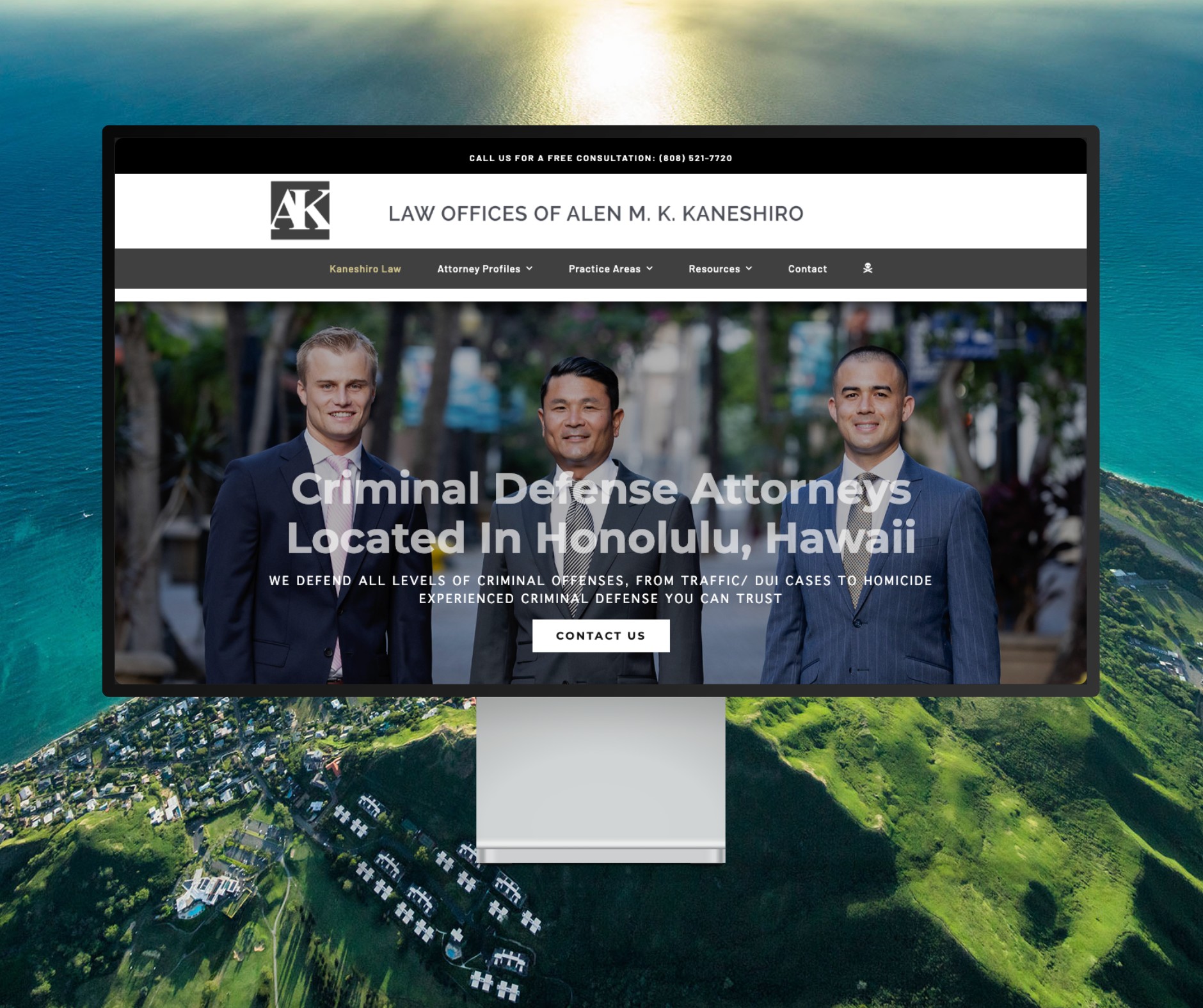
Featured Website: www.kaneshirolaw.com
Kaneshiro Law Firm, one of Hawaii’s most respected legal practices, partnered with The X Digital three years ago for a complete website redesign. Since then, we’ve maintained an ongoing relationship—handling updates, optimizations, and technical support around the clock. Our dedicated team ensures they’re never without assistance, while our enterprise-grade hosting provides 24/7 uptime monitoring and reliability. Kaneshiro Law Firm is one of many long-term clients who trust us to keep their digital presence running flawlessly.